AI isn’t magic—and building real-world systems takes more than
just good ideas. This second post in the AI Fundamentals series
walks through how to identify high-impact projects, assess
technical and business feasibility, and navigate the core steps in
developing and deploying AI-powered systems.
Prasanna Arjunan• Dec 03, 2024 • 6:30 AM SGT
From AI Dreams to Practical Execution
In our opening post, we explored the foundations of modern AI
and the importance of input-output mappings, especially in
supervised learning. But understanding how AI works is just the
starting point. To create real business impact, companies must
move from abstract curiosity to concrete, operational projects.
So where do you begin? Often, it starts with a deceptively
simple question:
What’s actually worth building? The most
successful AI efforts don’t aim to automate entire job
functions—they focus on well-scoped, repetitive tasks where
automation can reliably deliver value. The sweet spot lies at
the intersection of what AI is good at and what your business
genuinely needs.
Take, for instance, a customer service operation. Rather than
attempting to replace a human agent outright, a far more
effective starting point might be automating ticket
categorization—routing support requests based on urgency, topic,
or intent. This task-level focus reduces risk and accelerates
value capture.
Similarly, an AI model that predicts demand for seasonal
inventory, based on sales history and weather trends, can
directly reduce waste and increase revenue. These aren’t flashy
moonshots—but they solve real problems.
And no, you don’t always need “big data.” A computer vision
model to detect cosmetic defects on smartwatches may only
require a few hundred well-labeled images to get started.
Validating Ideas with Technical and Business Diligence
Once a promising use case is on the table, it’s time for due
diligence. This isn’t a lengthy compliance ritual—it’s a focused
effort to answer two critical questions:
Can we build it? and
Should we build it?
On the technical side, ask whether a model could realistically
reach the desired performance. Does your team have access to
quality training data? Can they iterate quickly enough to hit
milestones? Is the required infrastructure in place? If you're
building a fraud detection model that must reach 98% precision,
that bar needs to be evaluated early.
From a business lens, the stakes are equally important. What
happens if the model succeeds? Will it reduce costs? Unlock new
revenue? Support an existing strategic objective? These aren’t
afterthoughts—they shape prioritization and buy-in.
Many teams build simple spreadsheet models to scope timelines,
resource requirements, and expected ROI. It’s not about
precision forecasting—it’s about aligning expectations and
building confidence that the investment is worth making.
And don't overlook ethical diligence. An AI model that assists
with hiring or credit scoring may technically work but still
introduce harmful biases. Every decision to automate deserves
scrutiny beyond the bottom line.
Inside the AI Development Lifecycle
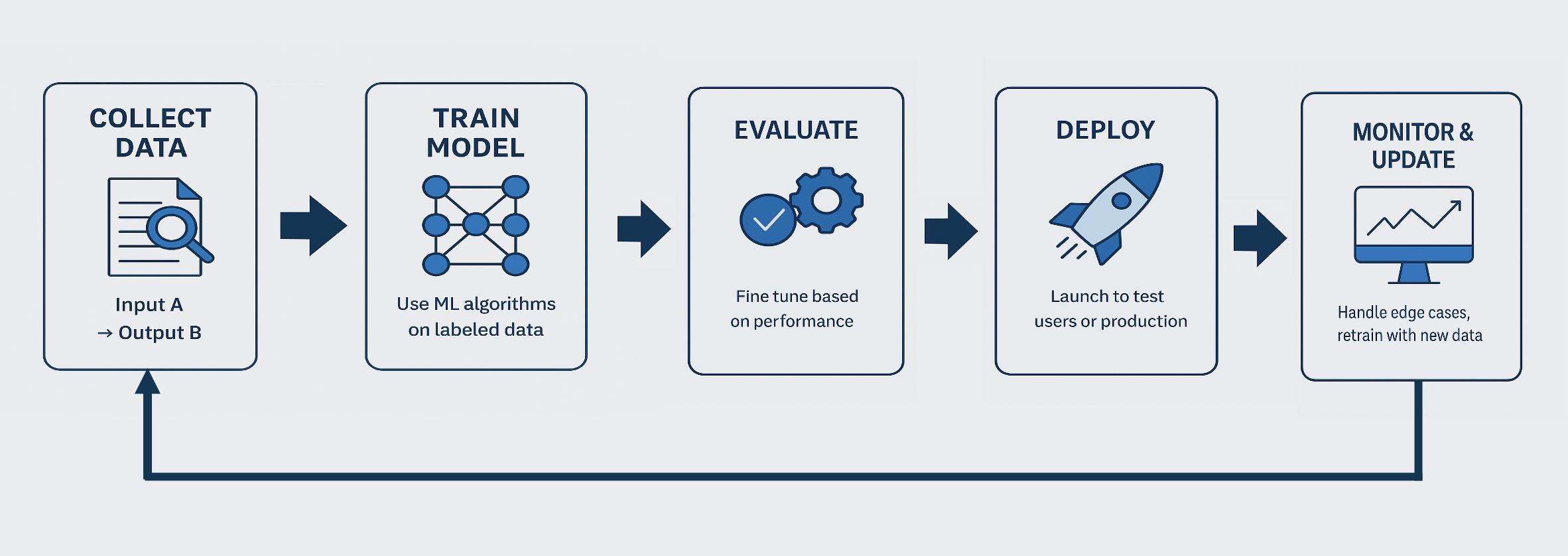
Once greenlit, real-world AI projects follow an iterative
loop—not a straight line. The workflow generally moves through
four key stages:
Collect Data: Every model starts with
examples—pairs of inputs and expected outputs. To build a
content moderation system, for instance, you need labeled
examples of posts and the rule violations (or lack thereof) they
represent.
Train the Model: With data in hand, the
engineering team applies machine learning techniques to map
inputs to outputs. Early versions often perform
poorly—refinement is part of the process. The team experiments,
tunes, and iterates.
Deploy: Once a baseline is achieved, the model
is packaged into an application or API and deployed into
production. This is where theoretical success meets messy
reality.
Monitor and Improve: After launch, new data
starts flowing in. Some of it will expose edge cases or
performance gaps. Monitoring these issues and retraining the
model ensures the system improves over time, not degrades.
The diagram below illustrates this cyclical process—a pattern
repeated across nearly all production AI efforts.
End-to-end workflow for developing, deploying, and improving
real-world AI systems
The Tools AI Teams Use to Deliver
Modern AI teams operate in a robust ecosystem of frameworks,
infrastructure, and deployment options. The core building blocks
include:
Frameworks: Tools like PyTorch, TensorFlow,
Hugging Face, and Scikit-learn power everything from
fine-tuned language models to classical regression tasks.
Hardware: CPUs run general workloads, while
GPUs (like those from Nvidia) and TPUs (from Google)
accelerate deep learning with massive parallelism.
Deployment Strategies: Depending on the use
case, models can be hosted in the cloud (e.g., AWS, GCP), run
on internal servers, or deployed at the edge—on mobile devices
or embedded hardware—for low-latency inference.
The choice of tools depends on your task, latency needs, privacy
concerns, and scale. But no matter what stack you choose,
effective collaboration between data engineers, ML scientists,
and platform teams is non-negotiable.
Data Science Isn’t Machine Learning—But They're Siblings
While often used interchangeably, data science and machine
learning serve distinct goals. Machine learning builds automated
systems—models that take new inputs and generate predictions or
classifications. Data science, on the other hand, focuses on
extracting insights to support decision-making.
If your team is building a fraud detection engine that scores
transactions in real time, that’s ML. If you're analyzing web
funnel metrics to find where users drop off, that’s data
science. The distinction matters because it shapes staffing,
tooling, and project expectations.
Execution Over Hype
Across industries, AI is reshaping how we work—whether it's
helping sales teams prioritize leads, enabling precision
farming, or catching product defects on assembly lines. But hype
doesn’t drive results. Disciplined execution does.
That means building with clear goals, designing for data
collection from day one, running lightweight ROI assessments,
and preparing to iterate post-launch. It also means cultivating
teams and infrastructure that are optimized for long-term
learning—not just one-off pilots.
In the end, the companies that benefit most from AI won’t be the
ones with the fanciest demos. They’ll be the ones that
deliver, monitor, improve—and repeat.