The AI Transformation Playbook: From Projects to an AI-First
Company
This third post in the AI Fundamentals series explores what it
takes to go beyond standalone AI projects and become an AI-first
company. We’ll walk through a practical five-step transformation
playbook—starting with pilot projects and ending with
enterprise-wide AI integration—tailored especially for those
building in customer experience, contact centers, and CPaaS.
Prasanna Arjunan• Dec 05, 2024 • 7:45 PM SGT
From Early Wins to Enterprise Change
In our previous posts, we explored how AI works at a
foundational level— mapping inputs to outputs using data—and how
to identify practical opportunities to apply that power. But
solving one problem with AI doesn’t make your company AI-first.
The real transformation happens when you embed AI into your
operations, culture, and product DNA.
This shift doesn’t happen overnight. Most successful companies
take 2–3 years to evolve into mature AI-first organizations.
However, tangible results can often appear within 6–12 months if
the right foundations are laid. That’s where the
AI Transformation Playbook comes in—a practical
guide that outlines how to scale from scattered experiments to a
repeatable, value-driven AI strategy.
While these steps may sound like CEO-level guidance, they apply
just as much to technical builders, product teams, and
functional leaders looking to bring meaningful AI to their own
domains. Let’s walk through the five key phases—through the lens
of CX and communications-focused industries like contact centers
and CPaaS.
Get the Flywheel Spinning with Pilot Projects
Every transformation starts somewhere—and with AI, the best way
to begin is with targeted pilot projects. The goal here isn’t to
aim for maximum value right away. It’s to pick projects that are
technically feasible, scoped to succeed within 6–12 months, and
capable of demonstrating clear business impact.
For example, instead of launching a full AI-powered virtual
agent from day one, a contact center might start with a model
that classifies incoming emails or chats into categories like
“billing issue,” “product feedback,” or “technical support.”
Even modest improvements in routing accuracy and response time
can build stakeholder confidence and unlock further buy-in for
future investments.
These early wins are about more than just metrics—they help your
organization learn what it’s like to work with AI. You’ll start
answering important questions: How long does it take to label
data? What accuracy is good enough? How should humans stay in
the loop?
Just as Google’s early success with speech recognition catalyzed
broader AI investment across the company, your first projects
can create a flywheel of momentum—turning AI from an experiment
into a core capability.
Build an In-House AI Team
Once the first AI projects have shown promise, the next step is
investing in your internal capabilities. While it's common to
start with external vendors or consultants, long-term AI success
depends on building a team that deeply understands both your
data and your domain.
This often means forming a centralized AI team that supports
multiple business units. In a CPaaS or customer service
environment, such a team might include:
Machine Learning Engineers – to build and
fine-tune models for tasks like call routing, sentiment
detection, or agent assist
Data Engineers – to wrangle and unify
customer interactions from chat, email, and voice into usable
training datasets
AI Product Managers – to align model
development with real-world problems and prioritize the most
impactful use cases
As the team scales, collaboration with domain experts becomes
critical. Engineers can’t build effective models in
isolation—they need to partner with the customer support
managers, contact center supervisors, and agents who understand
the nuances of workflows, edge cases, and customer expectations.
Building this muscle internally doesn’t just speed up AI
development—it increases your organization’s strategic leverage.
Instead of waiting on vendors, you can move faster, experiment
more often, and solve problems that are truly unique to your
business.
Train Broadly Across the Organization
AI transformation isn’t just a technical initiative—it’s a
company-wide shift. For AI to take root, everyone from
executives to product leads needs a working understanding of
what AI can do, where it fits, and how to work with it.
This doesn’t mean turning everyone into ML engineers. Instead,
it’s about equipping different roles with the right level of AI
fluency:
Executives need to understand AI’s strategic
potential—how it affects the business model, what it takes to
build defensible advantages, and how to assess investment
timing and risk.
Functional leaders—such as heads of customer
service or CX—need to know how to scope viable AI projects,
evaluate performance, and collaborate with AI teams.
Technical talent needs deep training in
modeling, data management, prompt engineering, and
deployment—especially for LLM or voice-AI scenarios common in
CX.
In a contact center context, this kind of training could mean:
Running executive briefings on the business impact of voice
bots
Holding product workshops on AI agent-assist use cases
Setting up internal ML bootcamps for engineers building
classification or triage tools
This shared knowledge foundation improves alignment and speeds
up delivery. When everyone speaks the same language—business,
product, and AI—your projects become more realistic, more
grounded, and more impactful.
Forge a Strategic Vision
Interestingly, developing an AI strategy is positioned as the
fourth step, not the first. A truly thoughtful AI strategy can
only be formulated after a company has gained some practical
experience with AI through pilot projects, team building, and
training. This hands-on experience provides a deeper
understanding of what AI can and cannot do for your specific
industry. A well-defined AI strategy will guide your company in
creating value and building defensible competitive advantages.
A powerful concept to align your strategy with is the
"Virtuous Cycle of AI". This positive feedback
loop suggests that a better product leads to more users, which
in turn generates more data, enabling the creation of an even
better product. For a CPaaS provider, this could manifest as:
A better product: The CPaaS develops an
AI-powered sentiment analysis API that accurately detects
customer emotions during chat interactions, allowing
businesses to proactively address dissatisfaction.
Acquires more users: This superior,
AI-enhanced communication feature attracts more enterprise
clients to integrate the CPaaS's APIs into their customer
service platforms.
Collects more data: As more clients use the
sentiment analysis API, the CPaaS collects a vast and diverse
dataset of real-world customer chat conversations with
associated sentiment labels.
Enables an even better product: This
continuous influx of fresh, relevant data allows the CPaaS's
AI team to further refine and improve the sentiment analysis
models, making them even more accurate and robust across
different languages and contexts.
This self-reinforcing cycle makes the CPaaS's offering
incredibly difficult for new entrants to compete with, as they
lack the extensive, real-world data asset. Your data strategy
should therefore focus on strategic data acquisition,
potentially unifying disparate data sources into central
warehouses, and discerning what data is truly valuable.
Communicate the Journey
As your company moves from pilot projects to long-term AI
adoption, communication becomes just as important as
engineering. Whether it’s aligning teams internally or managing
expectations externally, how you talk about AI can accelerate—or
stall—your transformation.
Internally, transparency is key. Employees may
worry that AI will replace them or render their roles obsolete.
But with the right messaging, you can reframe AI as an
augmentation tool—not a threat. For instance, a contact center
rolling out AI agent-assist tools can emphasize how these tools
reduce repetitive tasks and allow agents to focus on solving
complex, meaningful issues.
Leaders should also share wins early and often. Even a modest
success—like improved response times thanks to smarter ticket
routing—can help rally the team and build cross-functional
support for AI initiatives. Don't wait until the final rollout
to celebrate progress.
Externally communication should focus on
impact. How are customers benefiting? What improvements can they
expect? Highlight real metrics—faster resolution, more
personalized service, better availability—and share your AI
roadmap when appropriate. This helps manage customer
expectations while positioning your brand as forward-thinking
and innovative.
Great communication can also help attract talent. Top AI
engineers want to work on meaningful challenges—not isolated
projects with vague outcomes. Showcasing your AI initiatives on
public channels like your website, blog, or conferences sends a
clear signal: this is a company serious about building the
future.
In every transformation, story matters. By clearly communicating
your AI journey—challenges, wins, and goals—you create buy-in at
every level and keep momentum moving forward.
Common AI Pitfalls to Sidestep
As you embark on this transformation, it's equally important to
be aware of common pitfalls that can derail your AI efforts. By
understanding these, you can proactively avoid them:
Don't expect AI to solve everything. While
powerful, AI has limitations. For instance, expecting a new AI
chatbot to immediately handle every nuanced and emotionally
charged customer interaction perfectly from day one will lead
to disappointment and frustrated customers.
Don't just hire a few machine learning engineers and expect
them to independently identify valuable use cases.
In a customer service context, an AI project to improve call
routing might fail if the ML engineers aren't closely
collaborating with veteran contact center agents who deeply
understand the various types of customer issues and the
nuances of human interaction.
Don't expect AI-based projects to work the first
time.
AI development is an iterative process. Implementing a new AI
model for predicting customer churn will require multiple
cycles of data collection, model training, testing, and
refinement before it achieves reliable accuracy and delivers
significant business value.
Don't expect traditional planning processes to apply
without changes.
The iterative, data-dependent nature of AI projects means that
traditional fixed-timeline project plans often won't fit.
Instead, work with your AI team to establish flexible
milestones and KPIs that make sense for AI, such as model
accuracy improvements over time rather than just fixed feature
delivery dates.
Final Thoughts — Building AI Maturity Over Time
Becoming an AI-first company is not about deploying a chatbot or
hiring a few machine learning engineers. It's about evolving how
your organization thinks, builds, and operates. It’s a
system-wide transformation—from strategy to culture to
execution.
The five steps we explored—pilot projects, team building, organization-wide training,
strategic planning, and transparent communication—aren’t just sequential checkboxes. They represent a flywheel:
each success strengthens the next, and momentum builds over
time.
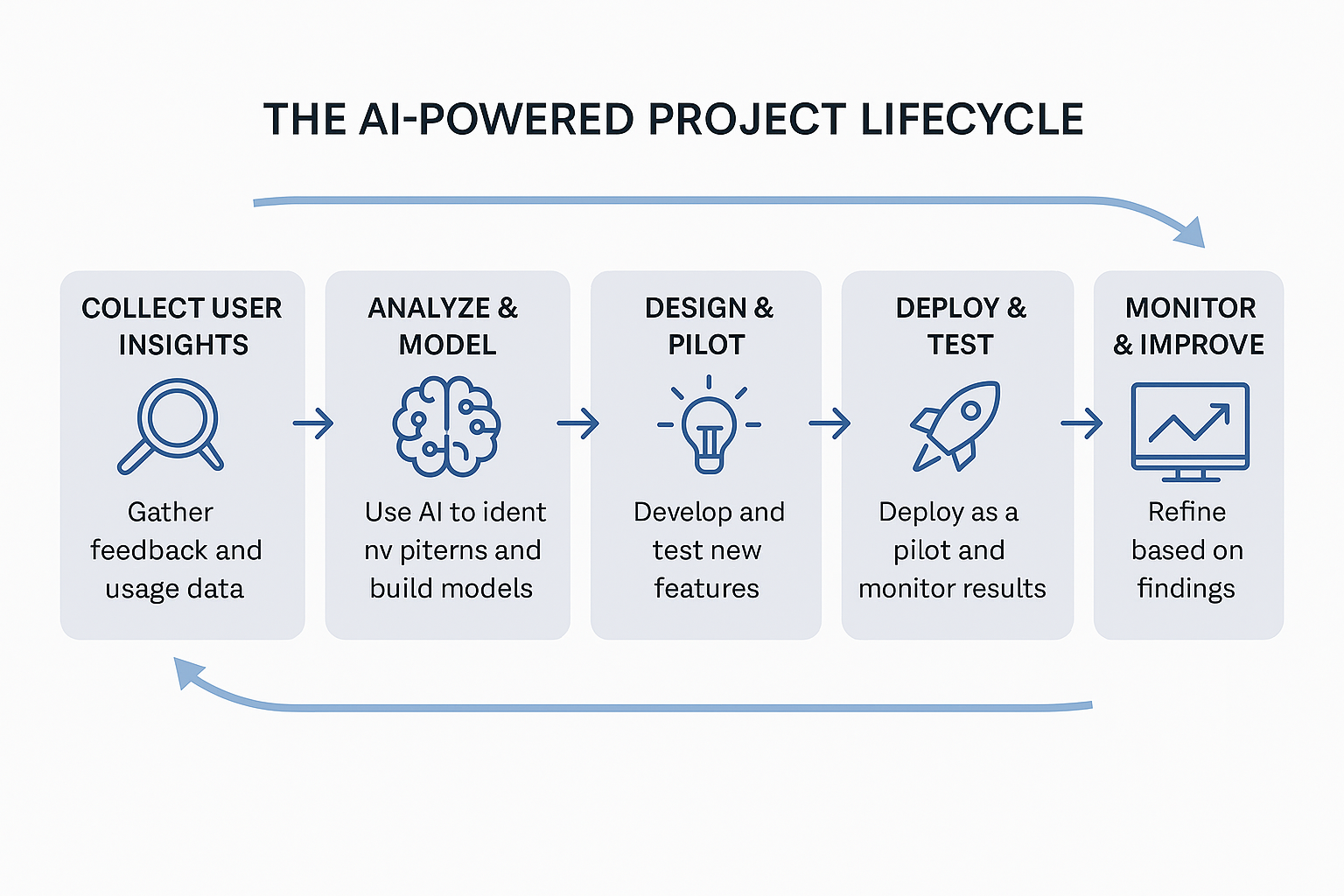
AI maturity isn’t a one-time effort—it’s built through a
continuous loop of feedback, modeling, deployment, and
refinement.
And while the playbook may sound “executive,” it’s not just for
leadership. Whether you're an engineer proposing the next AI
project, a PM shaping the roadmap, or a customer success lead
guiding AI-powered tools—understanding this transformation
journey helps you become a strategic force inside your
organization.
In our next post, we’ll explore the ethical and societal
dimensions of AI—covering challenges like bias, adversarial
attacks, and unintended consequences. As AI becomes more
embedded in CX and communication systems, responsible deployment
is just as important as technical capability.